Will Chavez murder be finishing touch for the Bush Administration?
October 8, 2008
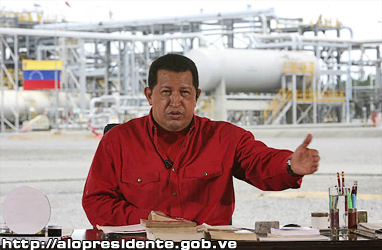
“Washington's high-ranking officials have long decided on how to get rid of me”- Hugo Chavez said citing reliable source in the ally countries in Western hemisphere, in Europe and in the US. He even hinted that he had the sources of information even in the U.S. Embassy in Caracas.
There are enough stories how the United States eliminated the unwanted Latin American politicians. Remember a Colombian 'populist' Jorge Eliecer Gaitan (killed in April of 1948), an Ecuador President Jaime Roldos (died in air crash in May, 1981), the leader of Panama Omar Torrijos (also died in a strange air crash in August, 1981). As a rule, Chavez mentions Salvador Allende, who was President of Chile until his death during the coup d'etat in 1973. Then the CIA and the U.S. military intelligence organized the coup to let Augusto Pinochet succeed Allende. All those politicians did not find support in the U.S and thus were doomed.
If we trace the chain of accusations Mr. Chavez has been facing over the past few years from members of the Bush administration, we'll see that there is only one more political leader who arises such hatred among the U.S establishment-Fidel Castro. However, after Fidel officially stepped down, they view Chavez as their major rival in Latin America. He is opposed to the U.S in all spheres: he carries out independent oil policy, tries to diversify energy supplies (treating China as the most preferable partner), takes steps to modernize the army of Venezuela with the help of Russia and China, welcomes a multipolar world model and supports “populist regimes” in Latin America.
Hugo Chavez initiated the creation of the South American military block to promote integration processes on the continent- a move which Washington could have hardly been happy about. All American military chiefs, who headed the U.S Southern Commandment, warned Chavez against such steps. The situation resulted in U.S preventive measures aimed at establishment of additional bases in the region, the 'revival' of the Fourth Fleet in the South Atlantic, a boost to the space surveillance system in Venezuela and all its allies, especially Brazil.
The strategic flights of the Russian Tu-160 bombers over the Caribbean and the Atlantic waters, their stay at the “Libertador” base in Maracay and the forthcoming visit of the squadron of the Russian North Fleet led by the “Piotr the Great” nuclear-powered cruiser provoke even greater annoyance of the White House hawks.
The conspirators failed to kill Chavez during the coup in early April of 2002. He was detained, but while he was transported from one place to another, there were always some loyal officers behind him to prevent the tragedy. They told the guards they would provide an adequate response if Chavez is assassinated.
After the coup failed, the U.S special services intensified the work aimed against the Venezuelan President. The journalistic dossier I compiled during the years in Venezuela consists of a few heavy volumes. If we add some video reports from the ultra-conservative Venezuelan and North American TV channels, containing straightforward statements against Hugo Chavez, and hundreds volumes of the so-called “anti-Chavez” literature, which is traded freely in Venezuela,- we`ll be able to imagine how intense are the impulses coming from numerous fanatic terrorists and the opposition members.
The CIA knows it perfectly well that sustainable work in the right direction will give necessary results- someone who is ready to sacrifice his life “for the sake of democratic ideals”. Sooner or later he will blow himself up near the presidential car. One does not have to be an expert to name the mass media in Venezuela which deal with this brainwashing: “Globovision” TV channel,newspapers “Universal”, “Nacional”, “2001” and “Zeta” magazine. Their major everyday task is to stir up hatred to the president. Hugo Chavez calls them “means of information terrorism”.
Another large-scale campaign against Chavez was implemented in May of 2004. It was prepared in Colombia, where apart from U.S military bases, there is located a CIA regional residence. With the help of its agents in the Colombian police (Departamento administrativo de seguridad), they formed a 100-member expedition group and sent it to Venezuela. The group comprised the “paramilitares”, rebels from the so-called department of self-defense, used in Colombia to fight the Marxist guerrilla groups.
Pretending to be season workers, the rebels arrived in the Caracas suburbs to settle at Roberto Alonso`s house. Alonso was one of the organizers of the 2002 conspiracy, a reliable CIA agent. The task was to seize the presidential palace Miraflores, to kill the president and, if the circumstances are favorable enough, to stage a coup against Chavez dictatorship. The organizers gave the rebels the uniform of the Venezuelan armed forces and were about to supply the weapons, when the country's counterintelligence interfered and arrested the rebels, who later face trial.
In late September of 2008 Venezuela`s special services uncovered the conspiracy of the acting and retired officers and the opposition extremist groups. During many hours of telephone eavesdropping, the special services managed to learn that following the CIA instructions, those engaged in conspiracy kept watching Chavez and tried to get information on his working plans. The final aim was to kill the Venezuelan President in September-early November, ahead of the national election of governors and alcaldes. According to recent opinion polls, the opposition has very few chances to win in all 22 states of Latin America. Due to this the scenario of Chavez`s assassination and the dissolution of the National Election Council was suggested as a means to undermine stability in the region and cause chaos and bloodshed. In case of a success, Chavez supporters would have been confused, and the conspirators would ask then the US to help them restore “true democracy”.
Military pilots on F-16 jets were also involved in the conspiracy- their mission was to attack the Miraflores palace from air. For the same purposes, the conspirators received AT4 grenade guns and Carl Gustav rifles with muzzle velocity of 150 to 700 meters per second. The country was rummaged for any kind of weapons, including M16 rifles and hand bombs. Some of the conspirators managed to escape to the Caribbean islands of Bonaire and Curacao, where CIA network used to be especially active. Others fled to Colombia.
It would be naive to think that ahead of the presidential elections in the United States, the CIA agents will stop their hunt for Hugo Chavez. The task has no deadlines, it must be fulfilled despite all scandals, huge expenditures and combat losses. The CIA always has alternative ways to follow. The problem is how to choose the right one to be able to say later “We have nothing to do with it”...