|
Artist Nicolas Ferdinandov in New-York:
mysteries of biography
Konstantin N. Zapozhnikov
March 27, 2005
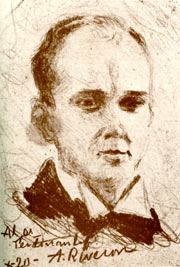 Next year – on April 14 – few connoisseurs and admirers of creative work of artist Nicolas Ferdinandov shall celebrate his 120th birthday. He was born in the family of Moscow intellectuals, studied in Art Academies of Moscow and St. Petersburg. In 1910 he acquired the profession of architect and scene-painter. He traveled a lot – Egypt, Italy, France, Caribbean sea islands, Venezuela. His paintings are full of unique spirit of Russian artist, who deeply absorbed the spirit of Russian culture. Certain impetuous energy abode in Ferdinandov and it compelled to act everybody, caught by its attractive power. It is not by chance, that the Venezuelan writer Romulo Gallegos devoted his novel “Stranger” the first title of which is symbolic – "Igniter of lighthouses".
The most mysterious period of the artist's biography falls into the period of his life in the Untied States – end of 1915 – beginning of 1918. It is known, that Ferdinandov was deputed to New-York by the railroad department of Russia to organize procurement of spares for American-made steam engines. But, because of hostilities in Europe, his mission turned out be difficult to fulfill, and his return home was delayed for a long time. As long as Ferdinandov was, first of all, the artist, scene-painter and jewelry designer, he decided to open a salon in New-York, where unique pieces of pearl and precious metals jewelry would be made to orders of the clients.
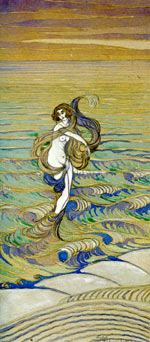 To get the real pearls the artist made several voyages to the Venezuelan island Margarita on board his tiny motor boat “Antonietta”. The glory about the talented goldsmith from Russia spread throughout New-York, and in the Russian colony of the giant city he was considered to be an adventurer-millionaire, connoisseur of the Caribbean sea and underwater pearl fields. Russian poetess Maria Moravskaya devoted her poetry to him, and Ilya Lvovich Tolstoy – son of the famous writer, - enthusiastically started to assist him in implementation of his project “Floating Academy”.The artists of different nationalities, in amicable company, were supposed to create in the name of piece and condemnation of war horrors aboard the ship, making the round-the-world voyage.
This ingenious pacifist project failed. The revolution of Lenin and the bolsheviks took place in Russia and the New-York port authorities confiscated the purchased by Ferdinandov ship, suspecting him in sympathies to the “reds”.
That was the main tragedy of his life. Everything had to be started from the beginning. To make things worst, financial difficulties and asperities ruined his family. His wife – Antonina Victorovna Sergeeva (Ferdinandova) – refused to join the artist in his trip to the distant and “not too much civilized” Venezuela, where Nicolas tried to establish his own business in collecting pearls.
It was in Venezuela that Ferdinandov could completely realize his potential. The Russian artist influenced the creation of modern art of Venezuela. His canvases occupy a worthy place in the National gallery of this country, and all the monographs, about the Venezuelan artists of the beginning of the XX century, mention his name.
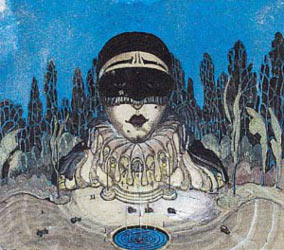 Until present the least known period of Ferdinandov's life remains his New-York period. The artist did not like to recollect his losses and that is why he did not leave any documentation of his stay in the USA.
Probably, the approach of his 120th birthday will activate the interest of today's “students of local lore” from Russian community in New-York to the personality of this original and properly not recognized creator, traveler and adventurer.
There is a chance, that some documents and materials about him might be kept in the archives of the Russian empire consulates, handed over to the funds of some US university. The unpublished letters and diaries of the poetess Moravskaya may contain recollections of the artist. It would be interesting to look through the Russian language newspapers (if any?) of New-York for 1915 - 1918. And what other city archives would it be worth diving in so that to find the “trace” of Ferdinandov?
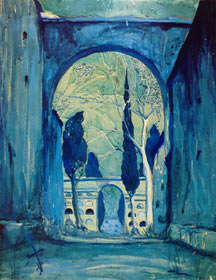 The documents, related to the fact of procurement and confiscation of the ship for “Floating Academy” by the pacifist-artists, are also of great value. Are there any records of Ferdinandov in the arts and jewelry catalogs of those times? It is quite possible that the pearl and mother-of-pearl jewelry, created by the Russian talent, might have remained till now in the hands of private collectors. Somebody might even possess his canvases.
It would have also been very interesting to learn about the further fate of his wife Antonina Sergeeva. The questions are many, and there is no doubt, that a fan-researcher will be found, who may unveil the mysteries of Ferdinandov's life in New-York just to the memorable date.
In case of any reproductions, reference to the site www.tiwy.com is a must.
More detailed information about the life and activity of Nicolas Ferdinandov can be found in Spanish in the following books:
|